1. Executive Summary
As next-generation autonomous systems, robotics, and industrial vision setups deploy into harsh operating environments, maintaining optical clarity against ice, spray, rain, mud, and dust without mechanical wipers or fluid reservoirs is critical. This need is especially growing for maritime drones. Ultrasonic Lens Cleaning (ULC) provides a solid-state alternative by using high-frequency vibrations to atomize water, eject debris, and deliver controlled acoustic/piezoelectric heating for rapid optical de-icing without secondary heating elements.
First-generation ULC solutions are limited by the need for higher voltages, required by single-layer piezoelectric rings, manufacturing fragility, and high cost. These limitations are multiplied when scaled to larger optical apertures. New Scale Technologies (New Scale) introduces a new modular ULC architecture that uses segmented, co-fired multilayer piezoelectric actuator (MLA) plates with smart driving methods. The result is scalable, lower-voltage lens-cleaning solutions for larger-aperture infrared (IR) and visible optical systems.
2. Technical Context and Industry Comparison
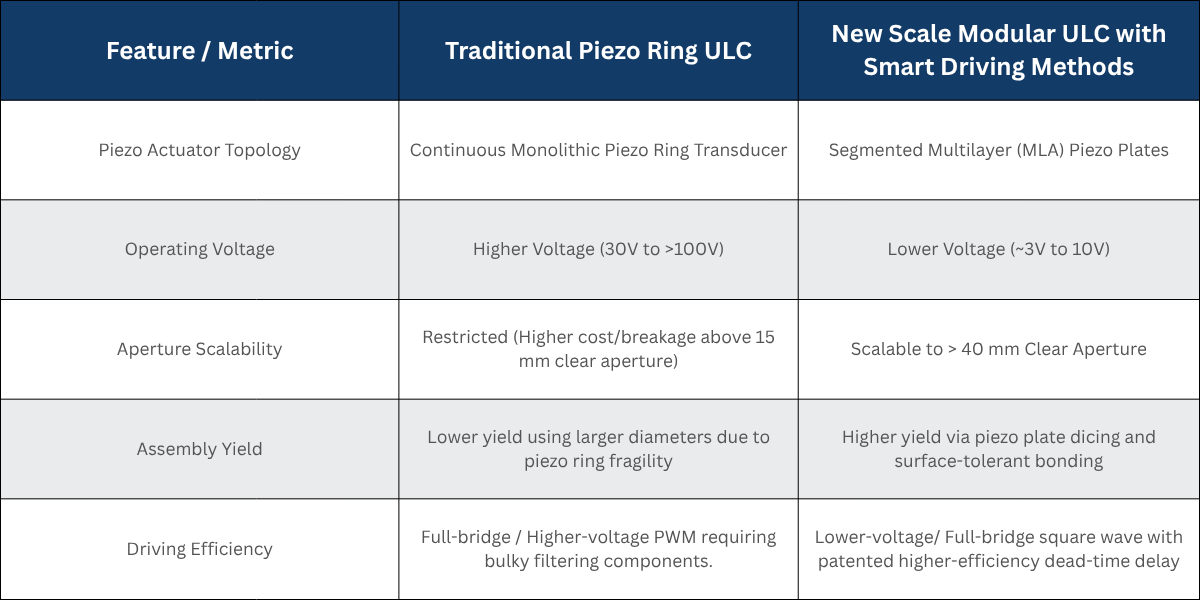
First-generation ULC architectures—such as those detailed in Texas Instruments’ ULC reference designs—primarily target smaller automotive camera apertures (e.g., <15 mm diameter) using solid piezoelectric ceramic (piezo) ring transducers.
While effective for small lenses, these designs present major bottlenecks when scaling to larger optics:
- Voltage Requirements: Monolithic piezo single-layer rings require higher driving voltages (30V – >100V+) to generate the required vibration amplitudes and surface accelerations.
- Manufacturing Yield and Cost: Large diameter piezo rings suffer from material waste during machining, challenging surface flatness requirements, and break easily during glass bonding.
- Aperture Limits: Scaling continuous piezo rings to clear apertures of 30 mm to >40 mm diameter increases piezo component volume, fragile handling, and overall bill-of-materials (BOM) costs.
To solve these limits, New Scale’s patent-pending ULC architecture replaces continuous piezo ring transducers with segmented, MLA piezo plates positioned at optimized nodal and anti-nodal zones along the optical substrate.
3. Performance Demonstration Case Study
To demonstrate modular ULC performance, New Scale designed, constructed, and tested a demonstration ULC system. The parameters were 50 mm Outer Diameter (OD), 2 mm-thick Silicon Long-Wave Infrared (SiLWIR) window with a 40 mm clear aperture.
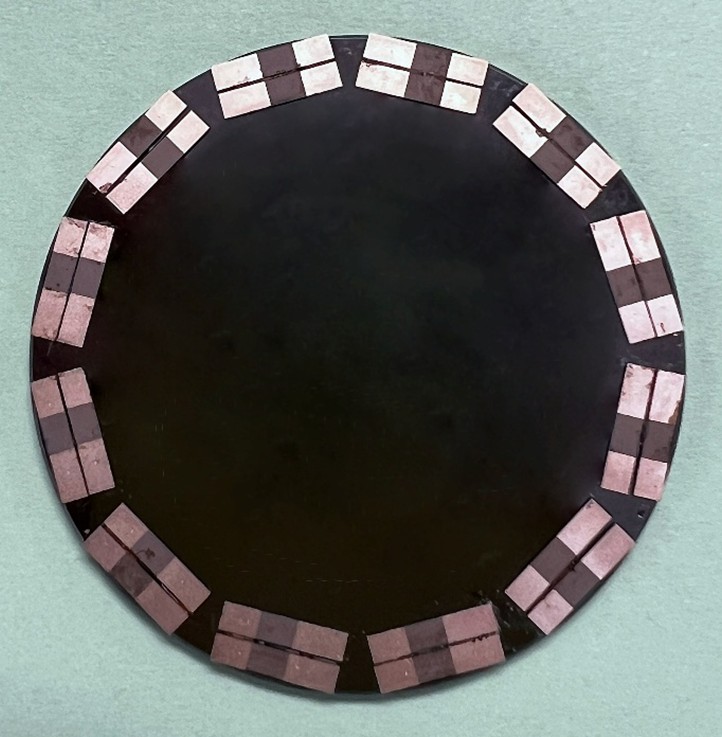
Figure 1: ULC demonstration featuring an annular array of segmented MLA piezo plates bonded to a 50 mm OD SiLWIR optical substrate.
3.1 Test Setup and Modal Analysis
The assembly integrated 24 co-fired in-stock MLA piezo plates (9.5 mm x 2 mm x 0.3 mm) epoxied in an annular array outside the clear aperture and wired via pre-tinned flexible printed circuits (FPCs). Finite Element Analysis (FEA) modal analysis identified three primary flexural bending resonant modes, which were confirmed via impedance analyzer measurements:
- 1st Axisymmetric Mode: ~10.0 kHz (Simulated: 10.7 kHz)
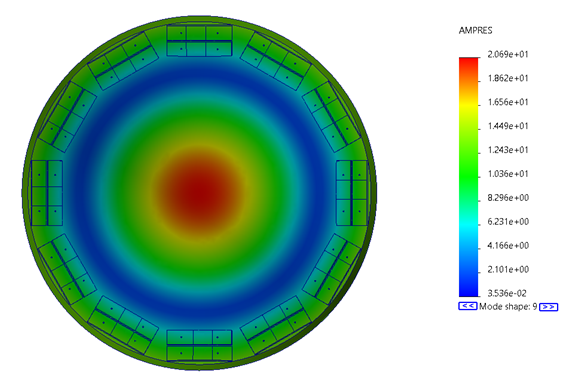
- 2nd Axisymmetric Mode: ~43.3 kHz (Simulated: 45.4 kHz)
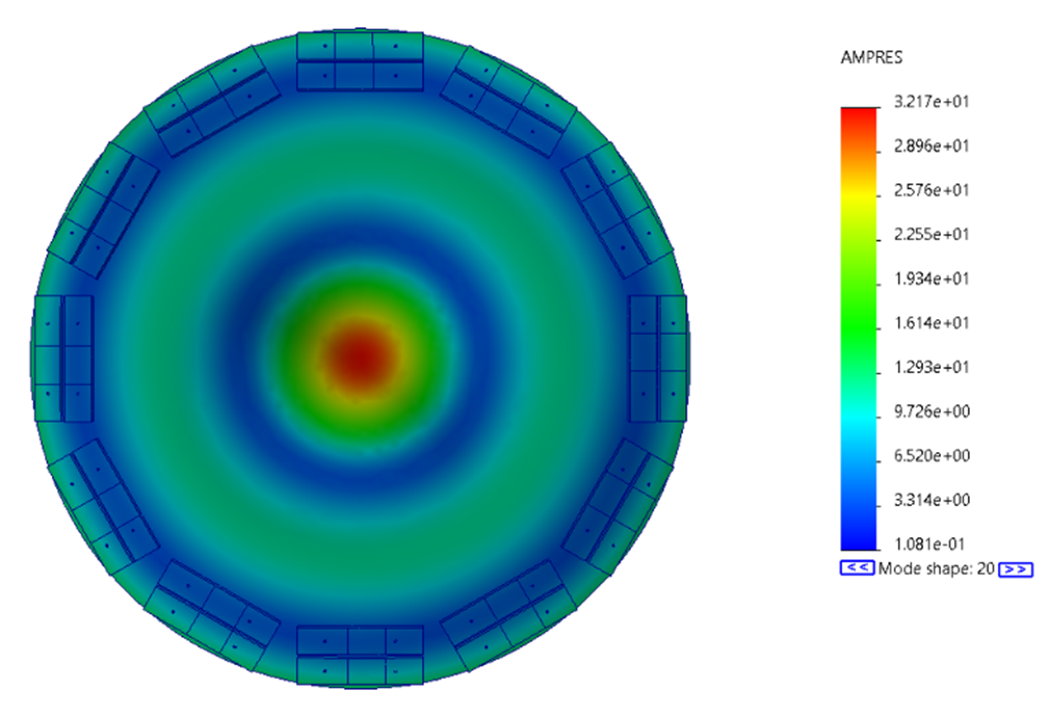
- 3rd Axisymmetric Mode: ~100.0 kHz (Simulated: 98.2 kHz)
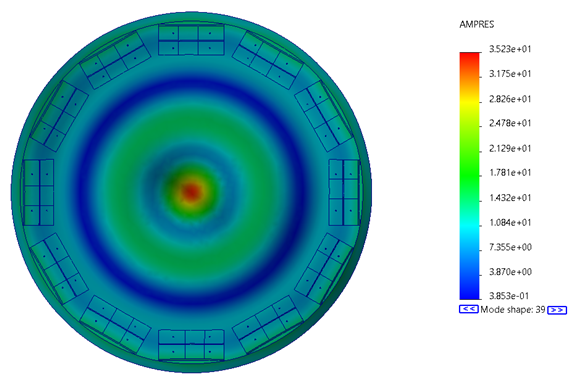
Figures 2–4: FEA displacement heatmaps corresponding to the 1st (10.7 kHz), 2nd (45.4 kHz), and 3rd (98.2 kHz) axisymmetric resonant modes.
3.2 Laser Vibrometer and Atomization Results
Driven at sub-10V inputs (9.9V max) using an in-stock smart electronics driver, we verified peak surface acceleration (ap) at the center of the silicon substrate using a laser vibrometer.
- Acceleration Threshold: Under proper clamping by seal rings, the 44.3 kHz mode generated an acceleration of 0.320 Mm/s^2, exceeding the theoretical threshold required for water atomization (ap-threshold = 0.110 Mm/s^2).
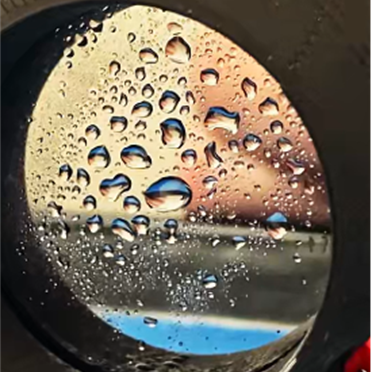
- Atomization Performance: Successful water atomization and clearing across a ~20 mm center zone was demonstrated on an uncoated silicon substrate.
(Before Atomization)
(After Atomization)
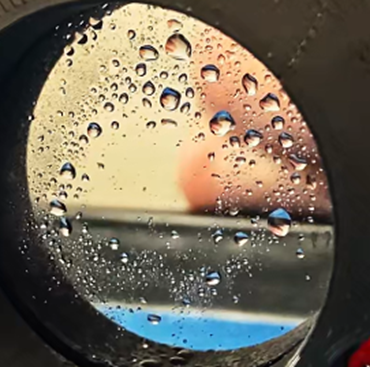
Figures 5–6: Image capture demonstrating water droplet atomization and clearing across the center aperture zone.
3.3 Future Work and Optimization
This case study demonstrates New Scale’s capabilities in ULC. Note that the segmented MLA piezo plates and the smart driver and control electronics used in this work were off-the-shelf components. Additionally, the window was not specifically coated to lower the acceleration threshold for water atomization or enhance cleaning performance. These factors limited the full-aperture window cleaning demonstration. With further optimization, a more efficient ULC, with a larger center aperture cleaning diameter, can be achieved.
Furthermore, when driven at or close to those higher resonant frequencies not used for atomization, the piezo plates can generate sufficient heat to quickly melt the ice accumulated on the optics. We will demonstrate this de-icing feature in the next phase.
4. Custom Engineering Capabilities
Every ULC deployment presents unique mechanical, thermal, and optical constraints. New Scale specializes in tailored end-to-end ULC design, leveraging key optimization techniques:
- Optimized Actuator Geometry and Placement: We engineer overall system architecture and adjust piezo plate counts, dimensions, and radial positions to align precisely with system nodal or anti-nodal rings, maximizing surface acceleration while minimizing mounting dampening. Dual concentric piezo arrays driven in opposite phases can be deployed to further boost modal displacement.
- Proprietary Actuator Driving Method: Selective piezo actuator driving schemes and tailored pulse timing effectively eliminate modal standing-wave dead zones, ensuring fluid atomization across a larger cleaning center aperture. In sub-freezing regimes, these drive algorithms switch dynamically to dedicated de-icing sequences that induce controlled localized heating before executing cleaning bursts.
- Acoustic Sealing and Clamp Design: Mechanical clamping can introduce significant acoustic dampening if improperly designed. By optimizing anti-node locations, lower-dampening seals extend modal resonant vibrations across more operating frequencies, thus maximize cleaning aperture with fixed allowed workspace or window diameter.
- Advanced Lower-Power Drive Control: Our proprietary drive algorithms utilize full-bridge square-wave signals incorporating dead-time delays between switching transitions, reducing drive power consumption by ~35%. Integrated thermal management, utilizing methods like Pseudo Voltage Control (PVC) or Hybrid Velocity Control, regulates drive signals under high temperatures to prevent depolarizing piezo elements beyond their Curie temperature.
- Surface Hydrophobic Integration: Applying hydrophobic/oleophobic coatings lowers the acceleration threshold (ap-threshold) needed for fluid propulsion, optimizing cleaning performance across a larger field of view (FOV).
This case study demonstrates that New Scale can produce larger aperture custom ULC modules that are easily integrated into your next-generation autonomous systems. We deliver all-in-one solutions that combine MLAs, a coated transparent window for IR or visible imaging, embedded drive and control electronics, all sealed in a fully tested and verified mechanical module. These modules require only DC battery power and digital commands for automatic window cleaning.
Contact New Scale to discuss your specific requirements: https://newscaletech.com/contact-us/.