R–Theta “Robot” Architecture Better Meets Science Objectives Compared to Previous Solutions
Next-generation spectroscopic telescopes are pushing fiber positioning systems to their limits. Instruments such as Spec-S5, MUST, and ESO-WST require higher fiber density, tighter spacing, and greater precision than ever before. These evolving requirements are beginning to exceed the practical limits of conventional fiber positioner architectures based on dualrotary, Theta-Phi, (θ-Φ) motion configurations. To address these challenges, we are developing a Radius-Theta (R-θ) fiber positioner designed to improve precision, reliability, and scalability for next-generation systems.
Increasing Fiber Density and Performance Requirements
To understand the shift in positioner design, it’s helpful to look at how system requirements are changing. Multi-object spectrographs use thousands of optical fibers to capture light from individual celestial targets. Increasing fiber density within the focal plane directly improves survey efficiency, allowing more targets to be observed simultaneously and reducing overall observation time. Next-generation systems introduce more aggressive requirements:
- 6.2 mm center-to-center spacing
- More than 25,000 fibers in a 1.8 m focal plane
- Positioning precision of 5 µm RMS
- 3.6 mm patrol radius
Traditional θ-Φ positioners use two offset rotary stages to place fibers across a patrol region. While effective in systems such as PFS and DESI, further miniaturization becomes increasingly difficult. Mechanical complexity, tighter tolerances, and the limitations of gear-based actuation all constrain performance at smaller scales.
How R-Theta Architecture Meets Astronomy Demands
To overcome these limitations, the R-θ positioner replaces dual rotary motion with a combination of radial (R) and rotational (θ) movement. This simplifies the mechanism while enabling operation in a much smaller footprint.
The system uses direct-drive Squiggle® piezoelectric motors for both linear and rotary actuation. By eliminating gears, the design removes backlash, reduces wear, and improves long-term reliability. The design meets the spatial constraints required for next-generation instruments:
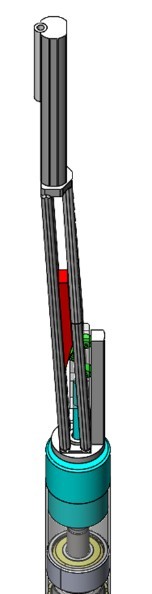
- 6.2 mm outer diameter
- ~156 mm total height
- 3.6 mm radial motion range
- <50 µm fiber defocus
These characteristics enable high-density packing without sacrificing performance. The motors also hold position with no applied power, reducing energy requirements and simplifying overall system design.
New Scale seeks collaboration partners in the astronomy community to ensure success of next-generation programs.
Integrating Piezoelectric and Coaxial Linear Motors
At the core of the design is a compact cylindrical architecture that integrates rotary and linear motion. A rotary piezoelectric motor provides full 360° motion of the upper assembly through a hollow shaft. A coaxial linear motor drives a threaded screw along the central axis. This motion is transferred through a pin and converted into radial displacement using a wedge and flexure mechanism.
This kinematic conversion is key to the system’s performance. The flexure geometry enables controlled radial motion while maintaining low Z defocus across the full travel range, critical for maintaining optical alignment. By combining direct-drive actuation with a simplified motion chain, the design reduces mechanical complexity while maintaining precise, repeatable fiber positioning.
Key Performance Advantages of R-θ architecture
Direct-drive piezoelectric actuation eliminates backlash, enabling consistent and repeatable positioning. At the same time, the R-θ geometry reduces torsional stress on the optical fiber compared to θ-Φ designs. This improves optical performance while reducing mechanical stress on both the fiber and the actuator system. The coordinate system also simplifies motion planning and collision avoidance. This reduces computational complexity and can shorten system reconfiguration times, an important factor in large-scale survey operations. Reliability is further improved through mechanical simplification.
The linear actuator operates through the center of the rotary axis, eliminating moving wires and reducing failure points within the system. In addition, the motors operate at approximately 10 V, enabling compact electronics without high-voltage circuitry. The design also supports integrated linear and rotary sensors for closed-loop positioning, allowing faster convergence to target positions when required.
Fiber Positioners Tailored with Drive and Control Electronics
Each positioner includes integrated drive and control electronics designed to fit within the 6.2 mm envelope. These electronics provide:
- ~10 V DC power input
- Communication via SPI, I2C, or EtherCAT
- Embedded motion control
- Local calibration memory
This distributed approach supports scaling to focal plane systems with tens of thousands of positioners while maintaining precise control at each node.
System-Level Considerations
While the R-θ architecture addresses many limitations of gear-driven systems, system-level optimization remains an important area of ongoing work. Key considerations that influence final instrument design and performance include:
- Fiber routing strategies
- Trade-offs between patrol range and Z defocus
- Control approaches (open-loop versus closed-loop)
- Environmental effects such as temperature variation and gravity orientation
The R-θ architecture enables high-density fiber positioning without the mechanical limitations of traditional designs. By combining direct-drive piezoelectric actuation with a simplified mechanism, it supports the precision, scalability, and reliability required for next-generation spectroscopic instruments.
Join Us at SPIE Astronomical Telescopes and Instrumentation
New Scale Technologies is excited to present this work at SPIE Astronomical Telescopes & Instrumentation, including a discussion of system design, actuation approach, and integration considerations for high-density spectroscopic instruments. Presentation Details Date: July 9, 2026 Time: 10:45–11:00 CEST Location: Room B2-M4